
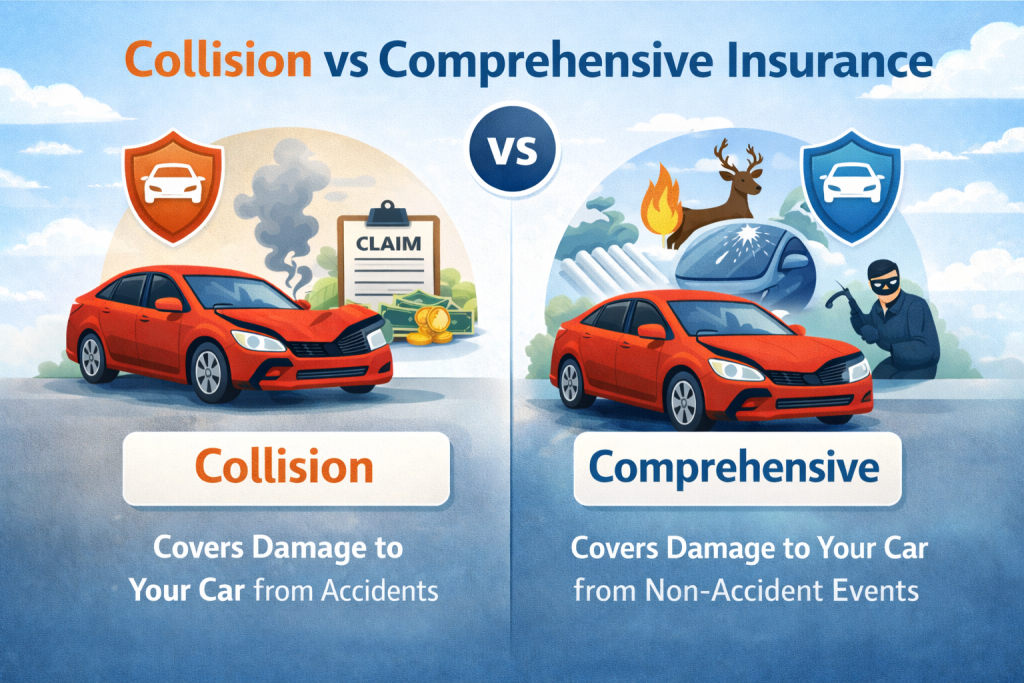
If you’ve ever compared auto insurance options, you’ve probably seen collision and comprehensive coverage listed side by side. They often sound similar, and many drivers assume they do the same thing. In reality, these coverages protect your vehicle in different situations. Understanding the difference between collision vs comprehensive insurance can help you avoid coverage gaps, choose the right deductibles, and build a policy that matches your car’s value and your budget.
In plain English: collision insurance is about crash damage, while comprehensive insurance is about non-crash damage (like theft or weather). Below, we’ll break down what each one covers, what it doesn’t, how deductibles work, and which coverage makes sense for different types of drivers.
Quick Comparison: Collision vs Comprehensive
Here’s the simplest way to remember it:
- Collision: damage to your car from a crash (with another vehicle or an object).
- Comprehensive: damage to your car from non-collision events (theft, vandalism, fire, storms, and more).
Both are typically optional unless required by a lender or lease agreement. Both usually come with a deductible.
What Does Collision Insurance Cover?
Collision coverage helps pay to repair or replace your vehicle after a crash, regardless of who is at fault. It generally applies when your car is damaged due to impact with something.
Common Collision Claim Examples
- You hit another car at an intersection.
- You rear-end a vehicle in traffic.
- You slide on a wet road and hit a guardrail.
- You hit a pole while parking.
- Your car rolls over (in many policies).
If you only have liability insurance, collision damage to your own vehicle usually won’t be covered. That’s why collision coverage is a key part of what many people call “full coverage.”
What Collision Insurance Typically Does NOT Cover
- Mechanical breakdowns or wear and tear.
- Damage from theft, vandalism, fire, or storms (that’s usually comprehensive).
- Damage to someone else’s vehicle (that’s liability coverage).
What Does Comprehensive Insurance Cover?
Comprehensive coverage helps pay for damage to your car from events other than a collision. It’s sometimes described as “other-than-collision” coverage because it protects against a wide range of unpredictable risks.
Common Comprehensive Claim Examples
- Theft or attempted theft damage.
- Vandalism (keying, broken windows).
- Fire damage.
- Storm damage (hail, wind, flooding in many cases).
- Falling objects (tree branches, debris).
- Animal-related incidents (depending on policy terms).
Comprehensive coverage is especially valuable if you park outdoors, live in an area with severe weather, or own a vehicle that would be expensive to replace if stolen.
What Comprehensive Insurance Typically Does NOT Cover
- Crash damage from hitting another car or object (that’s collision).
- Routine maintenance and normal wear.
- Damage that happens during illegal activity or intentional damage.
Deductibles: How They Work for Collision and Comprehensive
Both collision and comprehensive usually have a deductible, which is the amount you pay out of pocket before the insurer pays the rest of a covered claim.
Example: If your deductible is $500 and the covered repair costs $2,500, you pay $500 and the insurer pays $2,000 (up to policy terms and limits).
Many policies allow you to choose different deductibles for collision and comprehensive. A common strategy is to choose a higher deductible for collision (where claims can be frequent) and a lower deductible for comprehensive (where certain events like glass damage or vandalism may be more likely depending on your situation). The best choice depends on your savings and your risk level.
Which One Is More Important?
There’s no universal answer, but you can decide based on risk:
- If your biggest risk is a crash (heavy traffic, long commutes, lots of driving), collision coverage may be more valuable.
- If your biggest risk is non-collision damage (theft, weather, vandalism, street parking), comprehensive coverage may be more valuable.
Many drivers choose both because they protect against different problems. Together, they offer broader protection for your own vehicle.
Do You Need Both Collision and Comprehensive?
You may need both if your vehicle is expensive to repair or replace. In many cases, lenders and lease companies require both coverages as part of the financing agreement. Even if not required, both coverages can be worth it if a major loss would create financial stress.
When Having Both Often Makes Sense
- Your car is newer or has high market value.
- You finance or lease the vehicle.
- You rely on the car daily and can’t afford a major loss.
- You park outdoors or in higher-risk areas.
When You Might Skip One or Both
If your car is older and worth relatively little, paying for collision and comprehensive may not be cost-effective. A simple way to evaluate this is to compare the annual cost of each coverage to your vehicle’s value and your deductible. If the premium is high and the payout would be limited by the vehicle’s low value, you may decide to focus on liability coverage instead.
Real-World Scenarios: Which Coverage Applies?
Scenario 1: You hit a guardrail
This is typically a collision claim because the damage comes from impact with an object.
Scenario 2: Your car is stolen overnight
This is typically a comprehensive claim because theft is a non-collision event.
Scenario 3: A hailstorm dents your hood
This is typically a comprehensive claim because weather damage is generally covered under comprehensive.
Scenario 4: You back into another car in a parking lot
Damage to your own car is typically covered by collision, while damage to the other car is typically handled by liability coverage (if you are at fault).
How to Choose the Right Coverage
To choose between collision and comprehensive (or decide to carry both), consider:
- Your vehicle’s value: Newer and more valuable cars benefit more from both coverages.
- Your budget: Higher deductibles can reduce premiums, but only choose what you can afford to pay.
- Your driving and parking situation: More driving increases collision risk; street parking and weather increase comprehensive risk.
- Your financial cushion: If paying for replacement would be difficult, broader coverage provides stability.
A practical approach is to choose deductibles you can pay without stress and review your coverage once per year as your car’s value changes.
Conclusion: Collision vs Comprehensive Insurance
The difference between collision vs comprehensive insurance is simple once you know the rule: collision covers crash damage, and comprehensive covers non-collision events like theft and weather. Both coverages usually include deductibles and are often carried together to protect your vehicle from a wider range of risks.
The best choice depends on your car’s value, your finances, and your risk exposure. If a major loss would be difficult to handle out of pocket, collision and comprehensive can turn an expensive surprise into a manageable cost.